
NICE guidelines
The National Institute for Health and Clinical Excellence (NICE) is the independent organisation responsible for providing national guidance on the promotion of good health and the prevention and treatment of ill health. Their role is to improve health and wellbeing by putting science and evidence at the heart of care decision making.
This policy describes how new and existing NICE guidance is processed and implemented within the practice.
Key principles
- All new NICE guidance needs to pass through a single gateway within the practice.
- Individual types of guidance require different approaches for the purposes of implementation.
- All guidance must be checked for applicability.
- All applicable guidance must be compared to current clinical activity.
- Where possible general clinical and other practices will be altered to meet the requirements of NICE guidance.
- Where practice(s) cannot be altered to reflect applicable guidance within a suitable time frame action plans for achieving full implementation will be drawn up.
- All implemented NICE guidance will be reviewed by auditing or using another quality assurance tool.
- The progress of NICE guidance through the dissemination and implementation stages will be recorded.
Scope
This policy applies to all newly published NICE guidance and to the monitoring of existing guidance. It applies to all staff involved with the dissemination, implementation or review of NICE guidance.
New guidance
All new guidance will be logged.
New guidance will be distributed to all staff members within the practice. The manager is responsible for disseminating this information to relevant clinical staff. New guidance will be assessed against two criteria by clinical staff with expertise in the relevant area: applicability and implementation.
All decisions made about the applicability or implementation of new guidance must be reported at the practice meetings.
Action planning
The action planning process is initiated when it becomes clear that the implementation of a piece of guidance cannot be achieved.
Variation from guidance
“Once NICE publishes clinical guidance, health professionals and the organisations that employ them are expected to take it fully into account when deciding what treatment to give people. However, NICE Guidance does not replace the knowledge and skills of individual healthcare professionals who treat patients; it is still up to them to make decisions about a particular patient in consultation with the patient and/or their guardian or carer where appropriate.” (NICE 2005)
Failure to abide by NICE guidance
Continued refusal to abide by the NICE guidance will be made a disciplinary matter if the dental management team and principal consider this appropriate.
Current NICE guidelines which are followed within dentistry include:
- Prophylaxis against infective endocarditis: antimicrobial prophylaxis against infective endocarditis in adults and children undergoing interventional procedures [CG64]
- Oral health promotion: general dental practice [NG30]
- Dental checks: intervals between oral health reviews [CG19]
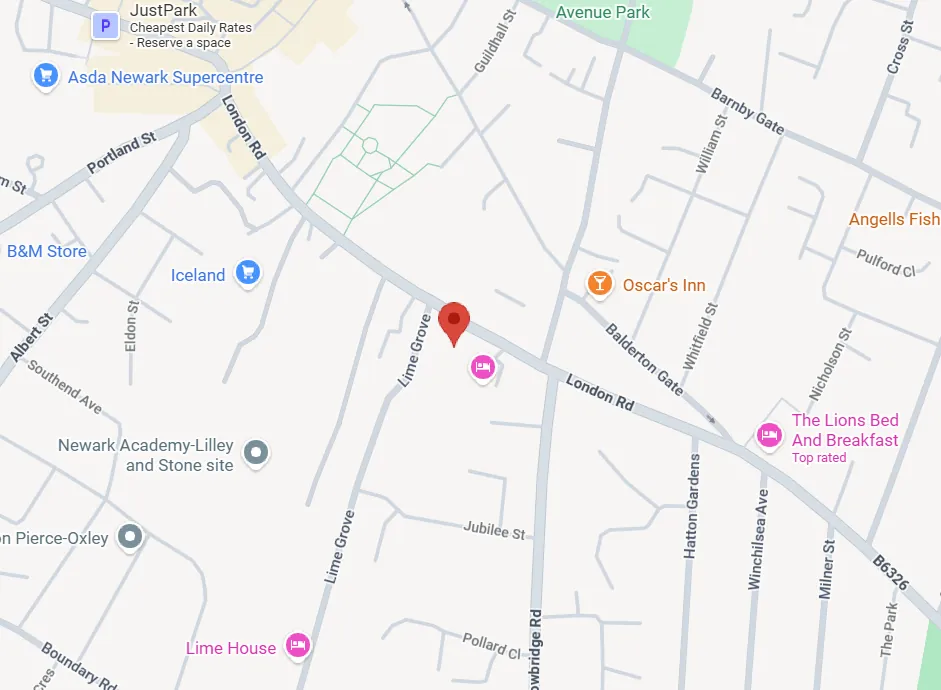
Find us on London Road.
36 London Road
Newark-on-Trent
Nottinghamshire NG24 1TF 01636 702241
Five minutes' walk from the town centre, close to the A1 and A46. Free on-site parking, plus pay and display at Deane Court Hotel (50p an hour, coins). Newark Castle and Newark Northgate stations are both under ten minutes away. Wheelchair accessible with downstairs surgeries and WC.